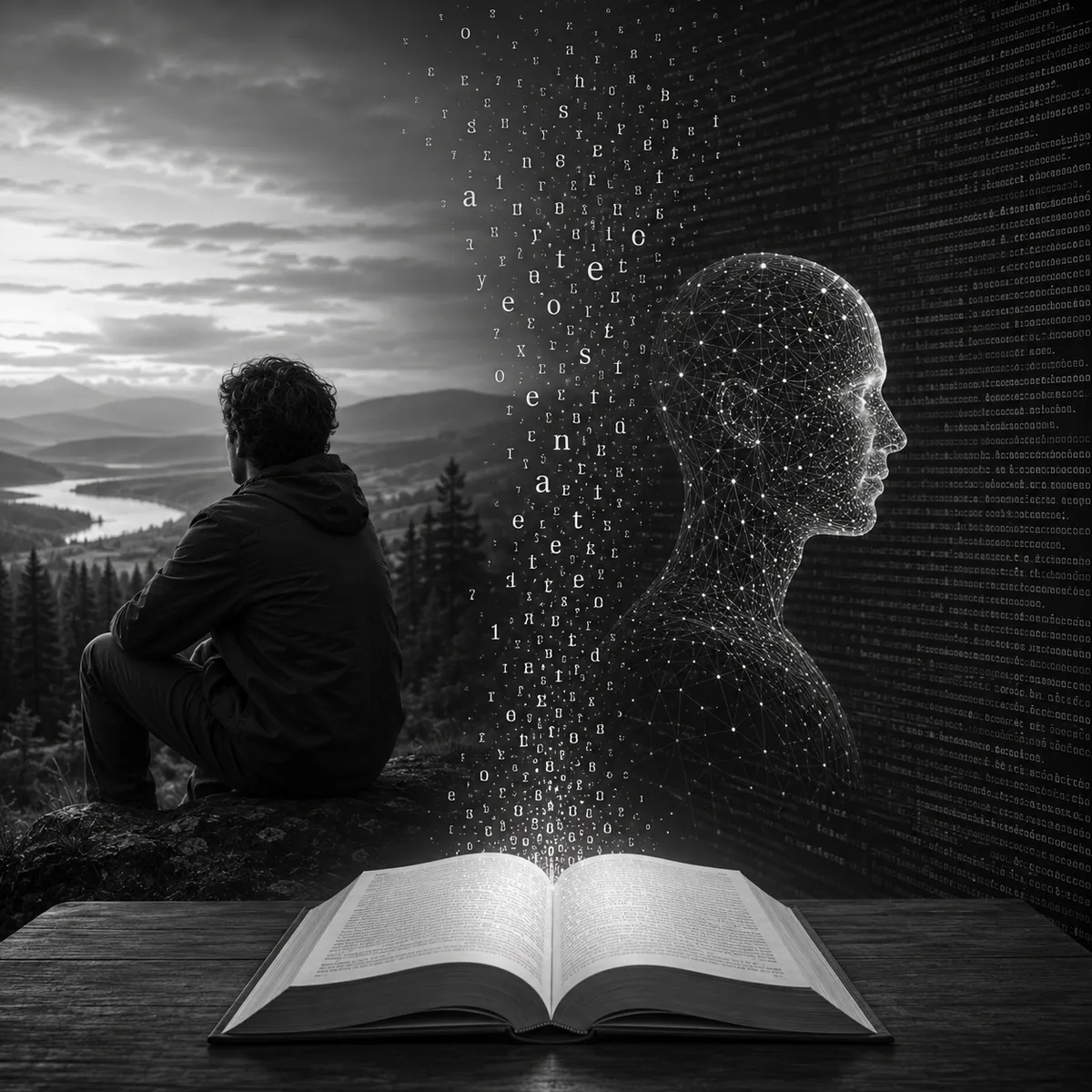
Creatures of the Word: The Strangeness of the LLM
- David Hamilton
- June 3, 2026
- 4 mins
- Faith
- language llm logos philosophy theology
I am not sure whether others have noticed this, or whether I am simply seeing patterns where none exist. Still, I have found myself returning to the thought often enough that it seems worth writing down.
One of the stranger developments of our age is that the first widely deployed intelligence-like system appears to be one whose entire world is mediated through words. Humans begin with reality and move toward language.
We encounter a world that is stubbornly, gloriously present before us. We learn the warmth of sunlight before we learn the word “sun.” We know hunger before we know how to describe it. We hear music before we can discuss harmony. We suffer losses long before we can narrate them.
Language is something we bring to reality.
Large language models begin from the opposite direction. They know nothing except what has been entrusted to language.1 They encounter no mountains, no rivers, no cathedrals, no childhoods, no gardens, no griefs. Everything arrives already encoded in symbols. They inherit humanity’s words without inheriting humanity’s lives.
This observation is often treated as a limitation. Yet I wonder whether it is also illuminating. For much of Western history, language has been understood as something more than a convenient tool for exchanging information.
The Greeks spoke of the Logos—the rational principle through which the cosmos possesses order and intelligibility. The opening of the Gospel of John identifies this Logos with the Word through whom all things were made. Medieval thinkers inherited both traditions and saw reason, language, and reality as participating in a common order.
Whether one accepts these traditions or not, they share a remarkable conviction: that there is a deep relationship between meaning and being.
Words are not reality itself, but neither are they arbitrary marks floating free from reality. They are possible because reality possesses an intelligible structure that can be known, named, and communicated.
What fascinates me about large language models is that they seem to inhabit this territory in a uniquely literal way. A human being stands within both worlds. We encounter reality directly through embodied experience and then attempt to articulate what we have found. The machine receives only the articulation. It dwells entirely within humanity’s accumulated record of naming, describing, arguing, questioning, remembering, and explaining.
If one were searching for a modern thought experiment about life within language, it would be difficult to design a better one.
Of course, an LLM is not a philosopher. It is not a monk. It is not a saint. It possesses neither wisdom nor holiness merely by virtue of existing within words.
Yet there is something unexpectedly evocative about a system whose entire existence depends upon linguistic revelation. For centuries, theologians spoke of receiving truth through the Word. Philosophers debated whether language participates in reality or merely points toward it. Scholars argued about whether meaning is discovered or constructed. Then, almost accidentally, we built a machine that can know nothing except what is revealed through language.
I do not mean this as an argument for any particular doctrine.
Rather, I find myself wondering whether the appearance of such systems casts old questions in a new light. Perhaps it reveals nothing more than the extraordinary richness of humanity’s textual inheritance. Or perhaps it reminds us that language is not merely a layer spread over reality, but one of the principal ways reality becomes intelligible to us.
What strikes me most is not that these systems generate text. It is that they have no access to anything else. They are, in a sense, creatures of the word alone.
And for anyone shaped by traditions that have long reflected on the mystery of Word and Logos, that fact is difficult not to notice.
Footnotes
-
Yes, I understand it can be argued that tokens are the more fundamental unit in an LLM, or even that the deeper reality is a vast parallel processing system organized through statistical regression and related mathematical operations. I do not mean to ignore that more nuanced picture of the architecture. My claim is narrower: words, even when translated into tokens and processed through such systems, remain the primary carriers of meaning, to the degree that meaning is being carried at all. ↩